What in the world could change with a desire as such?
-- the truth behind human freedom.

The earliest I remember of my aunt, Maina Mahi is both of us at a cassette store, and Maina Mahi trying to explain to the store boy the song I had sung to her. She tried to hum the tune. She didn’t remember the name of the movie. Perhaps she didn’t know. The tune escaped her mind every time she wanted to bring it back to her tongue. The store boy, I could see, was enraptured by her pool-black eyes and her pencil like collar bones. He couldn’t get a word of what she was trying to explain.
I was 5. I had the soul of someone who had sought love for a century. In some other lifetime. I could sing songs without ever knowing their meaning. I could sing them full and didn’t need the help of any written word. So I simply stepped ahead, asked Maina Mahi to come aside. And started singing, “tere dar par sanam, chale aye. Tu naa aaya toh hum chale raye” (I am at your door, beloved. Even when you’ve chosen not to come, I have).
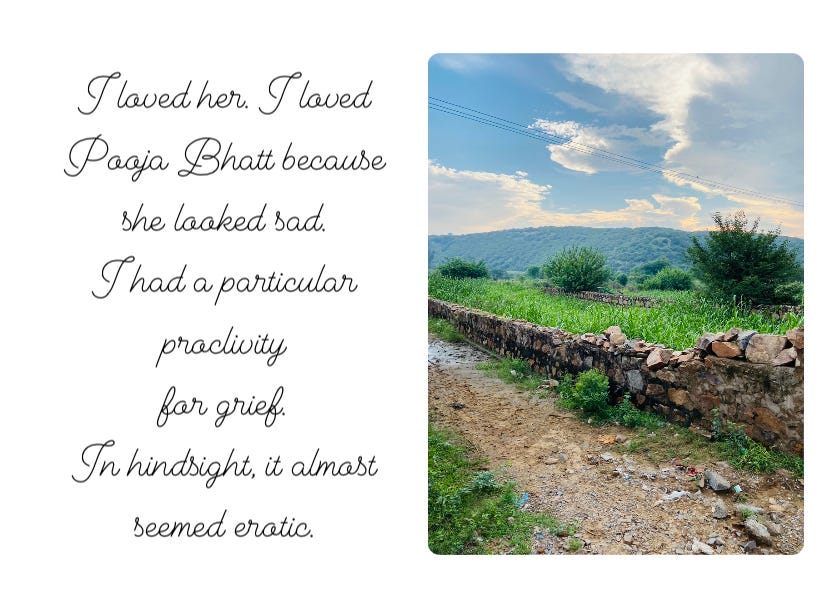
The store boy immediately gathered his senses and went behind the rack to get the cassette. Maina Mahi took it from him, and showed me Pooja’s Bhatt’s picture on it. I loved her. I loved Pooja Bhatt because she looked sad. I had a particular proclivity for grief. In hindsight, it almost seemed erotic. And so I loved Maina Mahi too. Her face felt like an ocean of grief. When she ate, like when she bit her food, a vein stuck out of the corner of her left eye. I found her most beautiful then. I would tell her, when I grow up, you must give me all your yellow salwar kameez. My love for yellow stems from there, I guess.
She was one person who never corrected me. She never said, you’re a boy. And boys don’t wear salwar kameez. She’d instead got me my first barbie and my first skirt. It was orange. She couldn’t find a yellow one. I once walked wearing it with her and my grandfather at the Rangia vegetable market. There was nothing more wonderful than that evening. And every time I think of her — I like to think, I want to think of her — in the middle of the market — everything moving into inviolate silence in her presence, the cacophony almost eviscerated from the air by the sharpness of her sheer beauty; I holding her hand and wondering, one day I’ll be as beautiful as her.
The day I stood beside her hospital bed and prayed that she kept breathing was the day I had hit rock bottom with my depression. When I came out of the room and saw the people outside waiting for the news, I fell to the floor. I had no strength left in my bones. I told Maa, she left. Maa sank in her own body, her frame giving away. My old grandfather, Maina Mahi’s father, fell to his knees.
She’d set herself on fire. Her face the remains of a dusty cloud, unrecognisable, mashed to its bones. Her whole body in stitches and layers of black soot. Covered by nothing but swathes of gauze and bandages. And that’s how she left.
We knew nothing of why it happened, and how did it escalate to this. But when few months later, her husband re-married, and I failed my gynaecology exams because of multiple panic attacks, Maa sat by me and implored with shaky breaths: You’ll have to let go of her, Baba.
She said, Maina Mahi had recently joined Amway. And she’d started making money. It wasn’t a lot. But it was enough for her to run the month for herself. She hoped to scale up soon, because she liked the business. She was meeting many people and they liked her. She’d say to Maa: “I don’t know why, but people take liking for me instantly, Mini-Baideow.” Maa would worry about her and ask her to be careful. People may have several things to say about a young married woman, the wife of a doctor, trying to do business by herself. She loved Maa a lot. And more than that perhaps respected her even more. So she told her the truth, that she was contemplating a divorce. It was becoming unbearable. The abuse. The screaming. The insults at home and the unnecessary suspicion about her whereabouts.
I’d recollect seeing bruises in the same place where her vein stood out. Her beautiful eyes sinking into their sockets. Just before she took her life, she’d filled for an insurance and managed to make Rs. 3 Lakhs.
A week back one of my old students called up. She’d been married for four years. It was a love marriage. She’d meet the guy on a trip to Berlin, and since then there wasn’t any looking back.
She dreamt of being a psychoanalyst, and thought that she and her husband both could go back to The Psychoanalytic School in Berlin on a scholarship. She tried several times, but it didn’t materialise. Either the scholarship didn’t come through or her parents refused to offer her the money.
She’d taken a few courses from me back in 2017 and I’d ask her to start practice immediately. As it happens with so many of us, we are in such love with the beauty of therapy and coaching — money almost feels like an antithesis to the whole purpose.
I urged her again in 2018. And then again in 2019. Nothing came out of her.
In all these years, she didn’t tell me about the situation at home. There were already suspicions and gaslighting happening. False claims of she going out all decked up and meeting strangers. Bruises and signs of sleeplessness. It was falling apart. She could neither go back to her parents, nor could she leave him. The husband had a garment store, and she was dependent on him for her finances.
Until just before the pandemic one day, she called and asked who should she go and see for therapy. I decided to send her to a colleague but I implored her this time, that she must start seeing clients herself. She, like many of my other students, said: but how can I begin or even heal others when I am myself in such a mess? And I told her what perhaps Maina Mahi deserved to hear from someone: there are people looking for this exact version of you. If you don’t show up, they lose faith in themselves. You may think that you are the weaker one, the helpless one in this situation. And I want to tell you — that there so many more who believe exactly in the story you believe about yourself. The truth is, you aren’t. The truth is they aren’t. And you get to change that for yourself. And for them.
So when she called a week back, she said: I’m finally free. It’s done. The divorce is through now.
I didn’t congratulate her immediately. Not that it felt odd. I have never cared about being odd. But it brought such thrill. It almost felt personal. I instead asked, what I always ask: how much do you make now?
She said, Rs. 3 Lakhs a month.
It took me almost a decade after Maina Mahi’s passing to walk with love in this world. To come to life. To believe that love doesn’t have to die midway. And that life doesn’t have to be about covering bruises and torn lips just because one needs to remain chained in a dead relationship — because of money. Infact money was never the inspiration behind anything. It was never what motivated me. It was love all along. The desire for something that doesn’t have to rot just because the essential nature of life is decay.
But then, things do rot. Things decay. Sometimes they fall apart. Sometimes, one needs to find a key to the rusty chains and unlock them and move out of muck. And that not just requires courage, but a real physical desire for freedom, for sustenance, for entrepreneurship, for personal abundance, for money. My Aunt had it in her. She had it all, so many years back. In a place like Guwahati. What she didn’t have was a different fate. What she didn’t have was a group of people telling her that she mattered. What she didn’t have was someone showing her what was safe and what wasn’t. What she didn’t have were kind eyes acknowledging her efforts and telling her that she was doing the best thing for herself by choosing her own freedom, making her own money. What she didn’t have were friends and loved ones telling her that she deserved to live a life free of abuse. And that they’d stand by her. Through everything.
And so I ask: Is choosing to have money — desiring it — ever about money? What in the world could change with a desire as such?
Love,
Gaurav.
P.S. Do write back. It’s comforting to know when we are loved.
I have just one word ' Love'. love how you shared, love Maina Mahi, Love your client who found freedom and love your essence.
You are a master storyteller. I needed to read this today